Social Drives
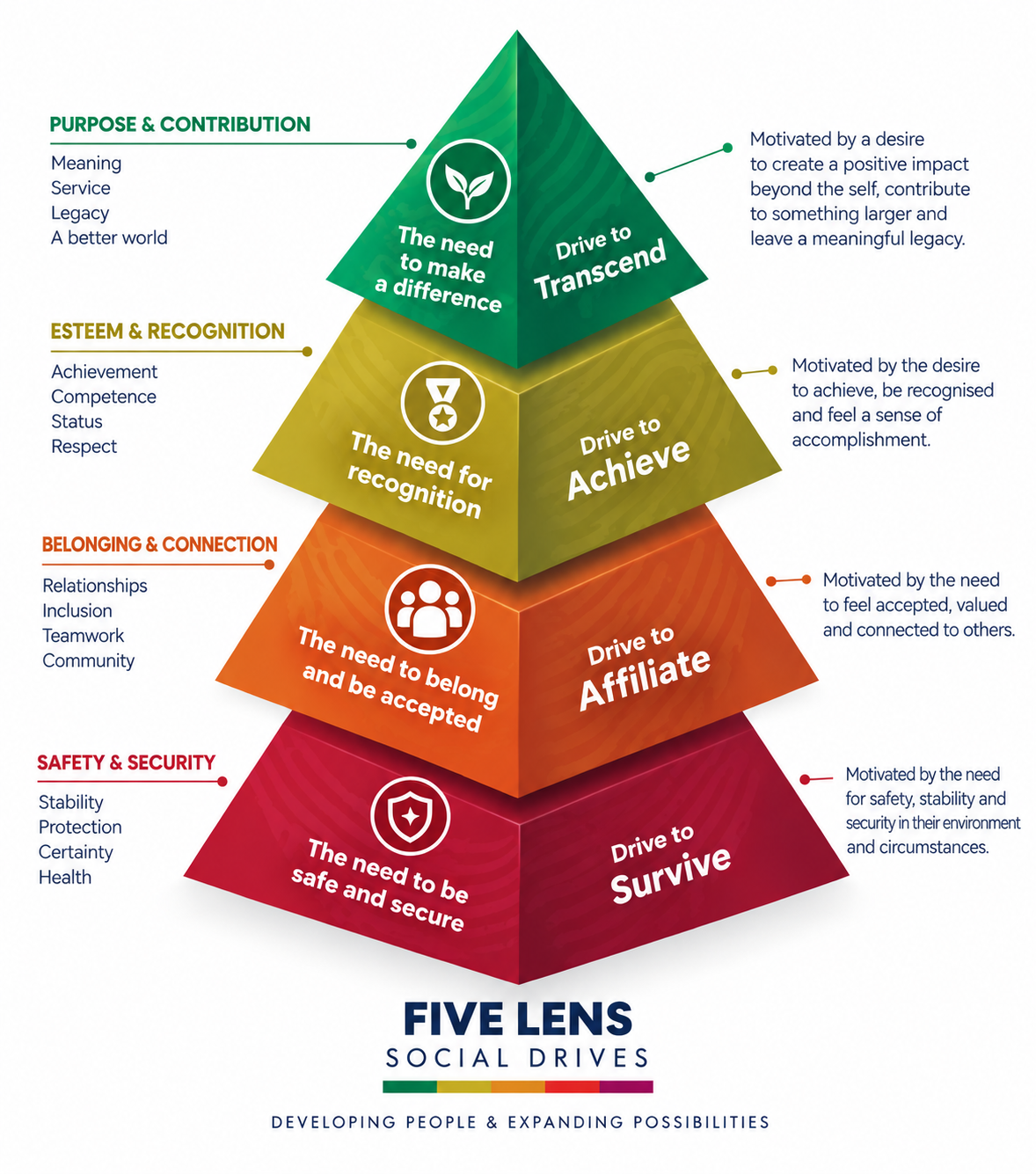
The Social Drives lens surfaces the needs and motivations that influence how individuals behave and interact — often without conscious awareness. Based on the models of Abraham Maslow and Richard Barrett, this lens assesses what truly drives a person at a given moment: from basic safety needs to belonging, recognition, and ultimately purpose.
By revealing these deeper motivational patterns, the lens helps individuals and teams understand where energy is flowing, where it’s being blocked, and how behaviour is shaped by underlying needs — not just personality.
How This Lens Fits Into the Five Lens Framework
While the Enneagram maps how people behave, it doesn’t always explain why. The Social Drives lens answers that question by identifying the core motivators — or unmet needs — behind a person’s actions.
By integrating this lens into the Five Lens model, practitioners gain insight into the forces that push behaviour beneath the surface. It supports clearer communication, more empathetic leadership, and more aligned team dynamics by addressing what truly matters to individuals at a motivational level.
How It Supports Coaching & Organisational Development
Understanding what drives someone — and what they’re avoiding — is essential in both coaching and team development. This lens helps coaches uncover what energises or demotivates a client and provides a pathway for shifting behaviour by addressing unmet psychological needs.
In organisations, it’s a powerful tool for shaping culture, improving engagement, and understanding how different team members find meaning and motivation. It supports leadership development, onboarding, and values alignment initiatives by helping individuals reconnect with what gives their work purpose.
The Hierarchy of Motivations
Inspired by Maslow and Barrett's value systems, the FIVE LENS framework evaluates where an individual's primary energy is directed. We categorize these into four primary domains of drive:
Security & Stability
The foundational need for safety, predictability, and structure. When this drive is dominant, individuals prioritize risk mitigation, clear boundaries, and financial or operational certainty.
Belonging & Connection
The relational need for acceptance, inclusion, and community. This drive fuels team cohesion, empathy, and the desire to build trust-based relationships within the workplace.
Esteem & Achievement
The need for recognition, competence, and respect. Individuals driven by esteem focus on mastery, performance metrics, career advancement, and contributing visible value to the organization.
Meaning & Purpose
The self-actualizing need to contribute to something larger than oneself. This drive inspires visionary leadership, innovation, and a deep alignment between personal values and corporate mission.
Navigating Met vs. Unmet Needs
Behavior in the workplace is largely dictated by whether our core Social Drives are being satisfied or threatened. By recognizing these states, leaders can shift their management approach to effectively re-engage their teams.
Energy contracts into self-protection. Employees may become territorial (Security), cliquish or overly compliant (Belonging), fiercely competitive or arrogant (Esteem), or disconnected and cynical (Purpose).
Energy expands into collaboration. Individuals feel safe to take calculated risks, communicate openly, share credit for successes, and mentor others for the greater good of the organization.
Effective leaders use the Social Drives lens to diagnose the root cause of team friction. Instead of just managing the resulting behavior, they actively design environments that fulfill these underlying human needs.