
Energy Centres
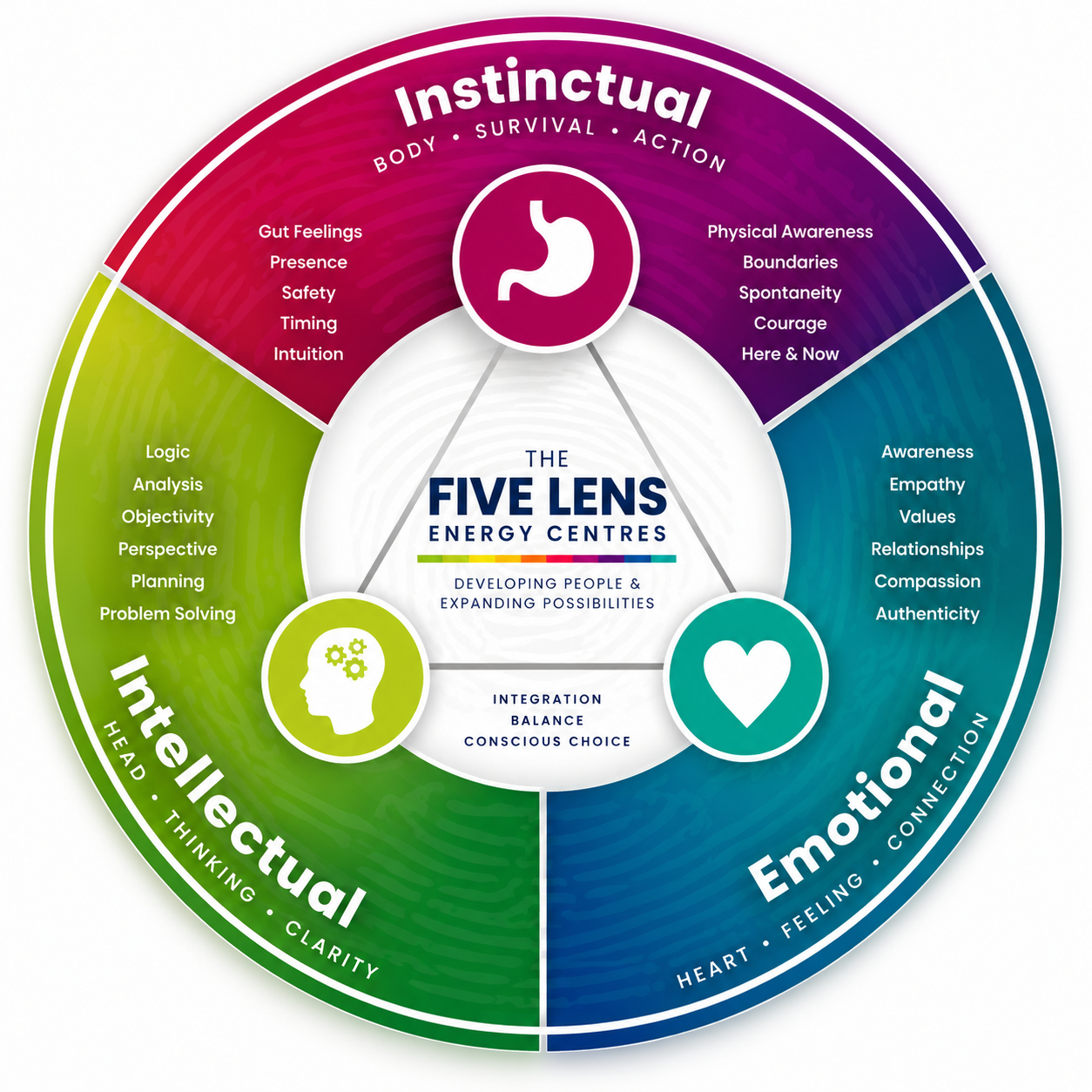
The Energy Centres lens explores how individuals process information and make decisions using three core systems: instinct (gut), emotion (heart), and reason (head). Each centre represents a distinct form of intelligence, and our behaviour often reflects the dominance — or neglect — of one over the others.
This lens brings awareness to how we respond in real time. It shows whether someone tends to over-rely on one centre or underuse another, and it highlights how integrating all three leads to more conscious, balanced action.
How This Lens Fits Into the Five Lens Framework
The Enneagram shows how people behave; the Energy Centres lens helps explain how those behaviours are decided in the moment. While most models focus on traits, this lens adds a dynamic, embodied layer to understanding real-time reactions.
In the Five Lens model, Energy Centres complement the other lenses by revealing the interplay between cognition, feeling, and instinct. It’s especially useful in leadership development, communication training, and conflict resolution — where misalignment between the centres often leads to indecision or misjudgement.
How It Supports Coaching & Organisational Development
This lens helps individuals and teams understand their default decision-making style — whether they lead with logic, emotion, or instinct — and how that affects outcomes. For coaches, it offers a practical way to help clients notice and shift how they engage with situations under stress or uncertainty.
In organisations, the Energy Centres lens supports better collaboration and communication by encouraging balanced thinking. It’s also valuable in leadership training, where the ability to integrate gut instinct, emotional awareness, and rational thought is essential for effective action.
The Three Core Systems
Within the broader FIVE LENS framework, the Energy Centres provide a dynamic layer for understanding real-time reactions and how behaviors are decided in the moment. We evaluate the utilization of three distinct processing centers:
Head Centre (Intellect)
The domain of reason, analysis, and foresight. When effectively utilized, this center provides objective clarity, strategic planning, and rational evaluation. Over-reliance can lead to analysis paralysis or detachment.
Heart Centre (Emotion)
The domain of empathy, relationship, and connection. When effectively utilized, it builds trust, fosters collaboration, and navigates complex interpersonal dynamics. Over-reliance can lead to emotional reactivity or boundary issues.
Body Centre (Instinct)
The domain of intuition, presence, and action. When effectively utilized, it provides decisive momentum, boundary setting, and practical execution. Over-reliance can lead to impulsivity or resistance to change.
Aligning for Maximum Impact
Effective leadership requires the harmonious integration of all three centers. When one center is chronically suppressed or over-dominant, blind spots emerge. The FIVE LENS model helps individuals identify their default center and intentionally activate the others to achieve a state of holistic alignment.
Requires mountains of data before moving forward, often missing the human element of change management or failing to act when rapid intuition is needed.
Prioritizes team harmony over necessary conflict, potentially avoiding hard business decisions or failing to establish objective performance boundaries.
Jumps straight into action without considering long-term strategic implications (Head) or the emotional impact the action will have on the broader team (Heart).
Gathers relevant data (Head), senses the impact on the team (Heart), and takes decisive, grounded action (Body). This alignment creates trust, clarity, and sustainable momentum.