Personal Mastery & Maturity
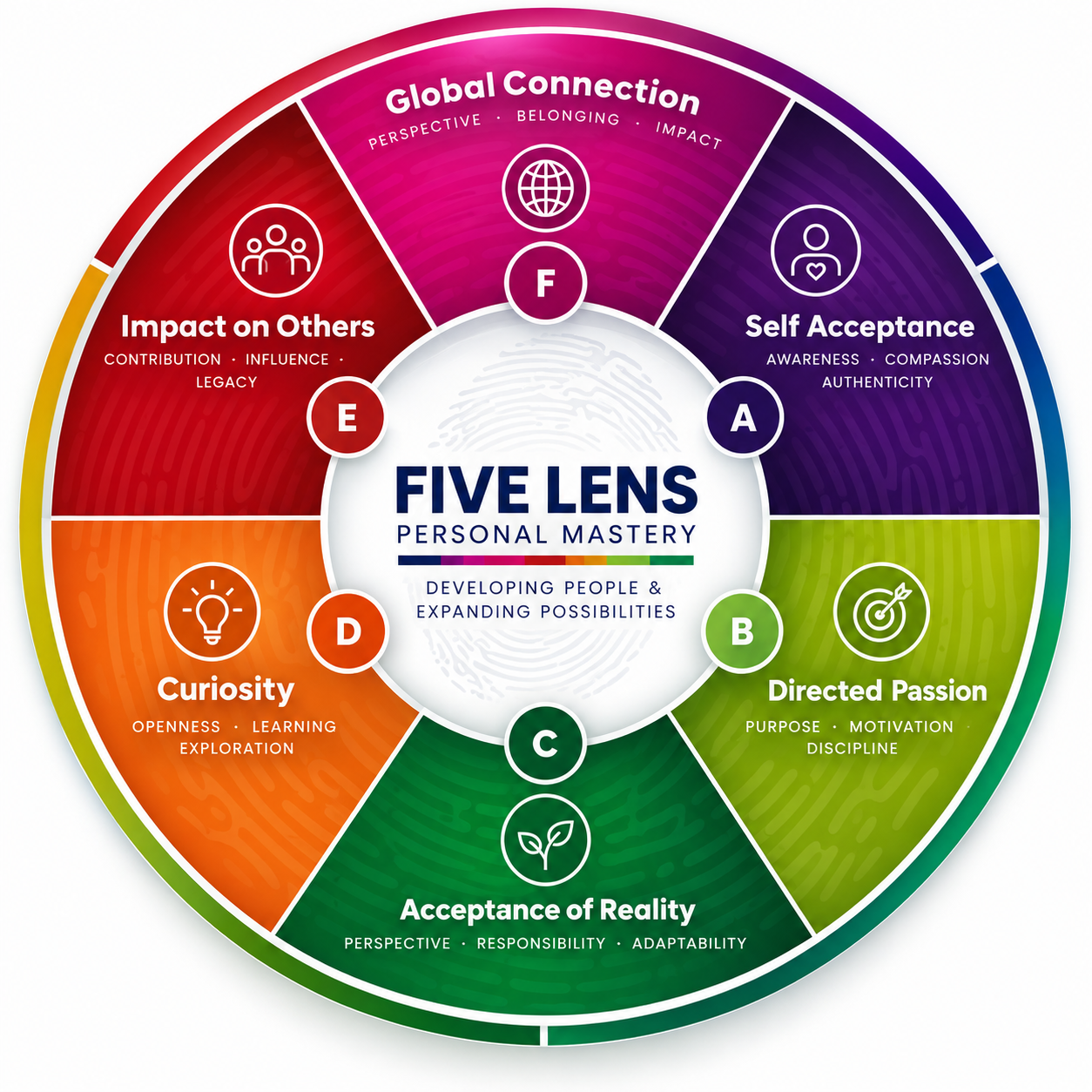
The Personal Mastery lens focuses on the internal drivers that influence how individuals think, relate, and act. Inspired by the work of Peter Senge, it assesses the mental, emotional, and motivational factors that contribute to personal maturity and the ability to navigate life with self-awareness and stability.
Rather than positioning mastery as a trait one “has,” this lens frames it as a lifelong discipline — the ongoing ability to stay grounded, learn continuously, and respond rather than react. Individuals with high personal mastery are not defined by perfection, but by their capacity to reflect, adapt, and grow.
How This Lens Fits Into the Five Lens Framework
While the Enneagram provides insight into observable behaviour, it doesn’t always reveal the deeper emotional beliefs and patterns that drive those behaviours. That’s where the Personal Mastery lens comes in.
By surfacing beliefs related to purpose, resilience, and connection, this lens adds a critical internal layer to the Five Lens model — allowing coaches and leaders to move beyond behavioural observation into true transformation. It gives language to a person’s readiness for growth and highlights the internal obstacles that may limit their development.
How It Supports Coaching & Organisational Development
The Personal Mastery lens helps uncover the thought patterns, emotional habits, and internal narratives that shape how individuals engage with the world. In both coaching and organisational contexts, it offers a structured way to work with limiting beliefs, support mindset shifts, and develop greater emotional maturity.
Whether applied in one-on-one coaching or as part of a leadership or wellbeing initiative, this lens enhances self-leadership, psychological resilience, and the capacity to grow in complexity.
Core Dimensions of Mastery
Personal Mastery is not a destination, but a continuous practice of refining how we engage with our internal world and the external environment. FIVE LENS measures across several vital dimensions:
Conscious Intent
The ability to align daily actions with a deeper sense of purpose and long-term vision, rather than being swept away by immediate pressures or organizational noise.
Emotional Agility
The capacity to experience complex, difficult emotions without being controlled by them. It involves moving fluidly through challenges rather than getting stuck in rigid defensive patterns.
Systemic Awareness
Recognizing that we do not operate in a vacuum. It is the ability to see the interconnectedness of our actions, our team's dynamics, and the broader organizational ecosystem.
Authentic Alignment
Closing the gap between our espoused values (what we say we believe) and our values-in-action (how we actually behave under stress).
The Shift: From Reactive to Proactive
A key indicator of high Personal Mastery is the widening of the space between stimulus and response. In lower states of maturity, leaders often operate on autopilot, reacting impulsively to triggers based on their Enneagram style's defense mechanisms. As Personal Mastery increases, individuals develop the capacity to pause, reflect, and choose a conscious, constructive response, even in high-stakes environments.
Defensive, driven by unconscious fears, blaming external circumstances, seeking immediate gratification or relief from anxiety.
Aware of triggers but still occasionally caught by them. Capable of course-correcting after a reaction and taking accountability for the impact.
Grounded, objective, and resilient. Able to hold multiple perspectives, regulate the nervous system, and act in alignment with core values.
Driving Outcomes
By revealing thought patterns and emotional habits, Personal Mastery helps leaders address limiting beliefs and foster significant mindset shifts. It is incredibly valuable for enhancing self-leadership, psychological resilience, and the capacity for continuous growth, in both executive coaching and enterprise-wide development contexts.